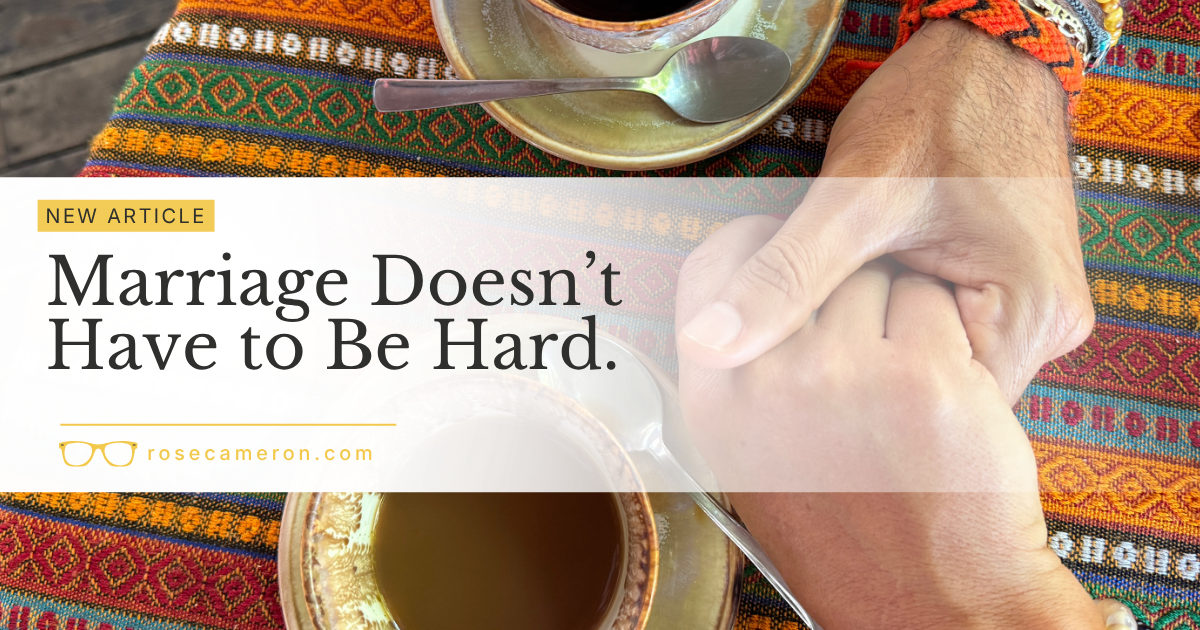
Marriage Doesn’t have to Be Hard
I am going to get some disagreement for saying this, but I do not think marriage has to be hard.
Sure, life is hard, people are complicated, and two people building a life together will encounter money, sex, illness, family, work, grief, exhaustion, resentment, changing bodies, different needs and the occasional argument about an object neither person remembers moving. Marriage requires honesty, patience, flexibility and work, and all of those things can be uncomfortable but I think we have become too willing to place every form of suffering inside the phrase “marriage is hard” and call it normal.
I notice this on dating shows and in conversations with friends. People talk about the merits of being “in the struggle together.” They say, “We’re fighting for this,” as though the amount of conflict proves the depth of the love. Surviving another year of marriage is worn like a badge of honor, even when both people seem exhausted and miserable. I understand fighting for someone when life is coming at you from the outside. There is something powerful about facing illness, grief, financial trouble or a family crisis together. But marriage itself should not be something we describe the same way we describe war. Your partner should not be the person you are constantly fighting, defending yourself against or recovering from.
Is Longevity the Real Measure?
When I was younger, I saw most adults treat longevity as the clearest evidence that a marriage had succeeded. If two people stayed together, the marriage worked. If they divorced, it failed. That is a wonderfully clean measurement, but it tells us very little about the quality of the relationship. People can remain married for decades while barely speaking honestly. They can organize an entire household around avoiding one person’s moods. They can become efficient roommates, careful performers or two lonely people protecting the appearance of a life. The marriage lasts, but the friendship, affection and individual people inside it slowly disappear.
I am not dismissing longevity. Building a shared history is meaningful, and staying together through a genuinely difficult season can be an extraordinary act of love. Illness, grief, caregiving, financial problems and family crises can place enormous pressure on even a healthy relationship. But time alone tells us only that the arrangement continued- it does not tell us whether the people living inside it felt known, respected, desired or free to tell the truth. An anniversary measures the passage of time only - it does not automatically measure the health of what happened during it.
Where Do We Fail?
Intimacy is a huge gap in most marriages. Growing up I heard most adults say, “After enough time attraction fades and marriage is just a friendship, so find someone you like.” Sex, affection and physical closeness are pushed behind everything else as if it’s ancillary. It makes sense for intimacy to change across different seasons of a relationship, but it cannot be indefinitely deprioritized without changing the relationship itself. Intimacy is touch, attraction, playfulness, vulnerability and the feeling that you are still choosing each other as lovers rather than merely cooperating as household managers. When physical connection disappears our vulnerability shrinks, our sense of emotional safety disappears, and we lose the magic that separates friends from lovers.
Likewise, the friendshipis important. As adults it’s easy to become so focused on running the household, raising children, making money and completing the relentless administrative work of adulthood that we stop enjoying each other. We talk about schedules, bills, groceries and what needs to be fixed, but stop being curious about each other. Friendship is treated as the pleasant beginning of a relationship rather than something that needs continued attention. Eventually, we know everything about what the other person is responsible for and very little about who that person is becoming. Is this a person you would choose even as a friend today? Are they a good friend to you? Are you being a good friend to them?
We wait too long to speak up. Many relationships also suffer because people wait far too long to say what is wrong. They swallow small injuries because they do not want to cause conflict, then quietly collect evidence until the problem has become a complete story about the other person’s character. By the time the conversation finally happens, it is no longer about the original comment, forgotten promise or disappointing evening. It is about six months of accumulated resentment, and both people arrive prepared to defend themselves rather than understand each other. Ask what the other person meant instead of arguing with the version created by your fear. Apologize without turning the apology into a defense. Deal with the actual injury before it recruits every previous injury to support its case.
Honesty is more demanding than simply not lying. It means saying what you need before punishing someone for failing to guess. It means admitting when desire has changed, when resentment is growing, when you feel lonely or when part of the relationship is no longer working. It also means being willing to hear an answer that makes you uncomfortable. A surprising number of relationships appear peaceful because one person has become highly skilled at keeping the other comfortable. If you are good at carrying things, people will hand you more. If you are good at smoothing conflict, the relationship may begin to depend on your silence. One day you realize the peace was real only because you were paying for all of it.
We confuse compromise for peace. A relationship will ask us to compromise but it should not require us to become unrecognizable. There is a difference between making room for another person and arranging your entire inner life around keeping that person comfortable. There is a difference between choosing kindness and withholding every truth that might create friction. There is a difference between forgiveness and repeatedly volunteering for the same injury. Constantly overriding your own needs is not proof that you understand commitment. It may simply mean the relationship has learned to function at your expense.
We need room to grow. People sometimes fall in love with a particular version of each other and then spend years resisting every change that follows. But nobody remains exactly who they were at twenty-five, thirty-five or forty-five. A healthy marriage must allow both people to become more fully themselves, even when that development alters the arrangement. Ideally, people grow together. Realistically, they will not always grow at the same rate or in the same direction. One person may be questioning a career while the other wants stability. One may need more independence while the other wants greater closeness. These differences do not automatically mean the relationship is failing, but they do require curiosity and negotiation. The danger begins when growth is treated as betrayal, or when one person keeps developing while the other refuses to examine anything and expects the relationship to remain exactly as it was.
The Actual Work
When people say marriage takes work, I think this is the work they mean, or should mean: Remain friends. Protect intimacy. Tell the truth before resentment becomes the primary language of the relationship. Address problems while they are still recognizable and solvable. Stay curious about the person beside you. Repair what you damage, and keep growing without demanding that the other person become less so you can feel more secure. We will miss cues, make selfish choices, speak badly and carry stress into rooms where it does not belong. We will occasionally react to something happening now with the full emotional force of everything that happened before. A healthy relationship is not one without rupture, it is one in which both people are willing to participate in repair.
One person cannot do that work for two - they can become the relationship’s full-time emotional mechanic, constantly trying to keep everything running while the other person ignores the warning lights. But love cannot be manufactured by the more conscientious partner. If only one person is being honest, initiating difficult conversations, protecting intimacy and trying to grow, that is not two people fighting for a marriage. It is one person fighting to keep it alive and that is what makes marriage “hard”.
I have come to believe that a good partnership should make both lives more possible, more fun, easier, and more fulfilling. Sure, there will be times when one person carries more because the other genuinely cannot. Love is not a perfectly balanced exchange in which every kindness is immediately returned. But across time, the relationship should create more honesty, more courage, more room to experiment and more freedom to become fully yourself.
Marriage Shouldn’t Be Survived
There is a cultural seriousness around marriage that sometimes mistakes misery for maturity. People say, “Marriage is hard,” with the same resigned tone they use for taxes and lower-back pain, as though disappointment is simply the membership fee for a respectable adult relationship. They describe years of conflict as though the difficulty itself proves commitment. “We’ve been through hell” becomes the central love story, even when hell was created inside the relationship rather than something the couple faced together.
I do not want that version. I want shared jokes, attraction, tenderness, direct conversations, ordinary rituals and two separate people who still have an appetite for their own lives. I want a relationship in which friendship is protected, where sex and intimacy are treated as important and uncomfortable truths are addressed before they become permanent walls. I want the relationship to be a source of strength when life is hard, not the permanent emergency that consumes all available strength.
That is not a promise that nothing difficult will happen. It is a standard for what we do with difficulty when it arrives. Do we turn toward each other or against each other? Do we become more honest? Do we address the injury or rehash old hurts? Do we remain interested in each other, or reduce the relationship to responsibilities? Does the marriage make room for both people to grow, or does one person keep becoming smaller so the structure can remain intact?
Marriage is not made meaningful by how much pain we can tolerate inside it or how proudly we can say we survived another year. It becomes meaningful through the friendship we maintain, the intimacy we protect, the truth we are willing to tell, the repair we make and the life we help each other live.
Life is hard enough. Marriage should be one of the places where we face it together, not another war we spend our lives trying to survive.