The Slow Death of Hacking Joy
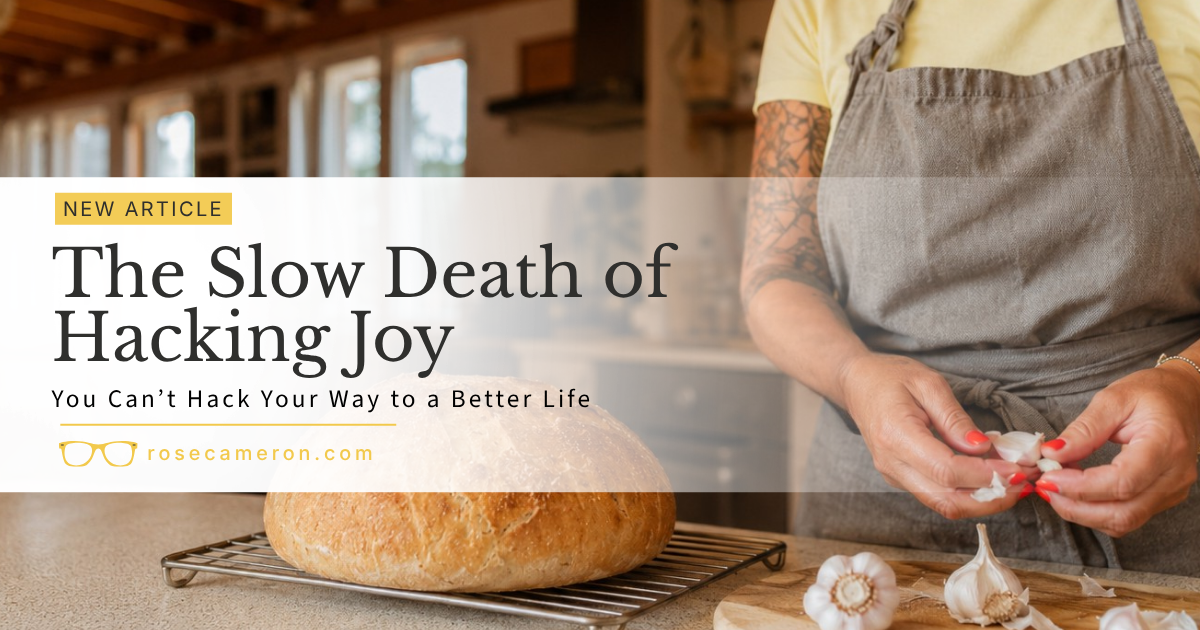
I’m kneading bread dough and thinking about how often people tell me they want to cook, but hate following recipes. They hate measuring ingredients. They want the romance of homemade food without the structure that makes homemade food work.
I lop the tops off carrots and trim the root ends from onions, tossing them into a small pot of water. A few peppercorns, a bay leaf, a pinch of salt, and the lid goes on while I do the rest of my prep work. People say making your own stock takes too much time, then wonder why their food does not taste as satisfying as they hoped.
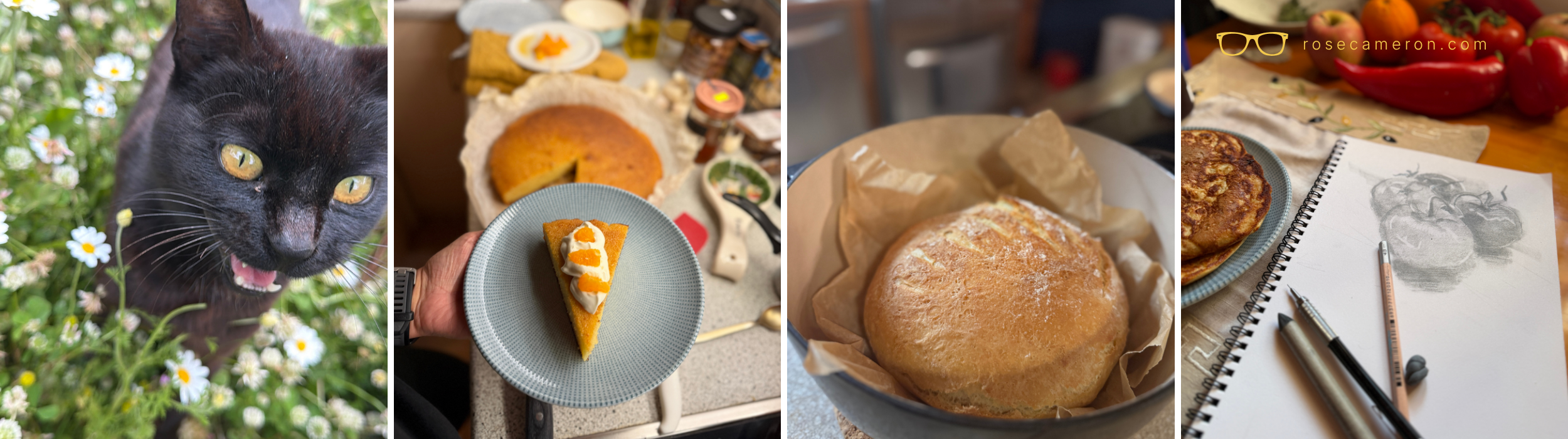
Outside, I pinch chamomile flowers from their stems while a black cat pounces on grasshoppers beside me. We occupy the same space with very different goals. I am making a chamomile and orange semolina cake. He is playing, snacking, or some combination of both. Store-bought tea would not come close to the golden, grassy brightness these flowers will bring to the cake.
This is the kind of thing we keep trying to skip.
Our culture prizes speed, efficiency, multitasking, and whoever can get the most done in the shortest amount of time. Multitasking has been shown again and again to be mostly nonsense, but we still treat it like a badge of honor. We answer emails while making lunch, listen to podcasts while walking, scroll while watching a movie, and then wonder why everything feels a little dull.
At the same time, we glamorize ditching a career to build an instagram-worthy slow life in the hills. We want the sourdough, the linen apron, the garden, the woodstove, the handwritten journal, the misty morning coffee, and the moral superiority of having opted out. But somehow we want all of that while still being force-fed 10,000 ways to get everything done faster, with less effort, more glory, and a payment plan for a $7,999 ten-week program.
We have turned even slowness into something to optimize.
Skill Comes After Structure
As someone with decades of experience in the food industry, I can tell you that a consistent end product comes from measuring. This is especially true in baking. Knowledge and measuring are the foundation. Skill and instinct follow.
Everyone wants to randomly throw things into a pan and have it become magic without first building the foundation. We want impressive results and no real time investment. We want to skip the boring part, the careful part, the repetitive part, the part where we learn why something works before we claim we have an intuitive gift for it.
I think about this as the fishermen motor out into the harbor on a chilly morning. The sun is not up yet, and it has to be bone-chillingly cold on the water. I make my coffee slowly, stirring the grounds into boiling water, setting a timer for four minutes, then pressing the filter down to extract a deep, rich cup. I think of the people who say they are too busy to make 4-minute coffee, yet wait in a drive-through line every morning for 10 minutes to pay someone else six dollars for corporate coffee in an insulated paper cup.
Convenience is not always convenient. Sometimes it is expensive avoidance dressed up as efficiency.
The Willingness to Bother
I had the pleasure of reading Jonathan Heppner’s poem the other day, which opens with an Anthony Bourdain anecdote: if you are too lazy to peel fresh garlic, you do not deserve to eat it. The quote and the poem have been living in my head rent-free ever since. I keep turning them over, not because I think garlic is a moral issue, but because there is something in that sentence we have almost entirely lost: the willingness to bother.
If you are looking for shortcuts, you can find them everywhere. There is a shortcut for cooking, a shortcut for fitness, a shortcut for business, a shortcut for creativity, a shortcut for confidence, a shortcut for healing, a shortcut for your morning routine, your marriage, your body, your attention span, your joy. But at some point, the shortcut cuts out the very thing you were looking for.
I get it, I was once looking for all the shortcuts and life hacks too. I wanted the better life, the stronger body, the clearer mind, the meaningful work, the beautiful home, the nourishing meals, the creative output, the deeper relationships. And I wanted to know how to get there faster. Early in 2025, I wrote about this in an article at The Joy Academy called The Magic Is in the Work You’re Avoiding. But the beauty of time and learning is that even the deepest ideas evolve as we do. Perhaps especially the deepest ideas.
The Magic You’re Looking For Is in the Work You Are Avoiding
Because now I don’t think the magic is only in the work we are avoiding. I think the joy is there too. Not all of it, of course. Some work is drudgery. Some systems should be improved. Some things deserve to be made easier. I am not interested in pretending that exhaustion is noble or that everyone should grind their own flour and handwash their sheets in a cold river. But there is a difference between making life more manageable and sanding every edge off the experience of being alive.
We keep selling ourselves the idea that the good life is on the other side of less effort, less learning, less waiting, fewer mistakes, less discomfort. Then we look around and wonder why everything feels strangely unsatisfying.
Joy was never meant to be hacked, and it is not the reward at the end of a perfectly optimized life. Joy is what appears when we are present inside our own lives long enough to notice them. The smell of garlic hitting hot olive oil. The slow bloom of coffee. The first warmth of bread coming out of the oven. The fisherman pushing into the dark harbor before sunrise. The black cat leaping through weeds after a grasshopper. The chamomile flowers staining your fingers with the scent of summer. These are not interruptions to life. They are your life.
Awareness: Convenience vs. Avoidance
This does not mean rejecting every shortcut. When I’m in the USA you bet I use the dishwasher, I have a roomba to auto-vacuum the house, and I order takeout when we’re tired. But I’ve learned to pay attention to the places where convenience is quietly becoming a crutch. Are you saving time, or are you avoiding participation? Are you simplifying your life, or are you removing the parts that make it meaningful? Are you using the shortcut because it helps you live better, or because you no longer know how to tolerate the slow, imperfect, necessary work of being fully present?
A full life requires a willingness to be inconvenienced by the things that matter. To sit with the person you love and have the hard conversation. To write the bad first draft. To go for the walk without turning it into content. To learn the skill badly before you learn it well. To stop trying to turn every human longing into a system, a hack, a funnel, a framework, or a ten-step process - and folks, I am a process girl as you know!
There is no shortcut to the kind of life that actually feels like yours. There is only attention and that is where joy comes back. Not through optimizing every corner of your existence until there is no mess, no friction, no waiting, and no ordinary labor left, but through remembering that some things are better because they take time.
The bread rises. The stock deepens. The cake perfumes the kitchen. The coffee blooms. The garlic sticks to your fingers. You are simply there, inside your life, paying attention.
That may be the whole point.