Homemade French Baguette
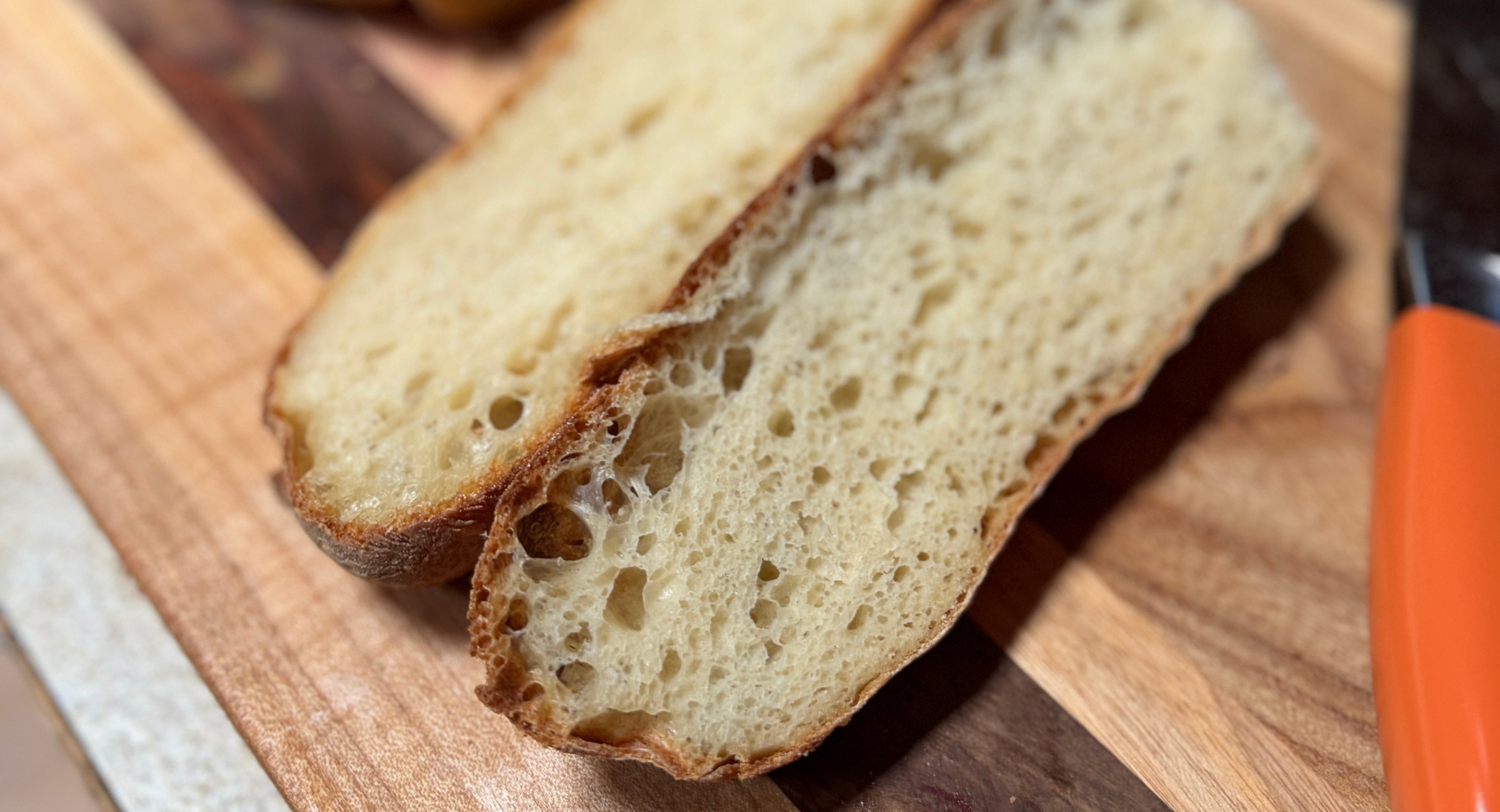
It all started with seeing Olympia Provision’s Saucisson Sec at the Portland Farmer’s Market when we were visiting the city the other weekend. My partner loves a good saucisson sandwich on fresh baguette and I figured since I had recently made whole grain mustard that would work beautifully with the cured meat, I might as well make the baguette too.
A baguette is made from an almost ridiculously short list of ingredients: flour, water, yeast, and salt. That simplicity means that anyone can make this and like most things culinary - it simply takes time and attention. The flavor comes from fermentation, the texture comes from handling the dough properly, and that wonderful crisp crust comes from a very hot oven and plenty of steam.
For this version, I use an overnight poolish. A poolish is simply a portion of the flour and water mixed with a tiny amount of yeast and allowed to ferment before you make the final dough. It takes about two minutes to put together the night before and gives the finished bread considerably more flavor.
I kept getting busy so the poolish sat out for 24 hours and then I used it. You can always refrigerate it (see longer directions below for more).
It also makes this a two-day recipe, but most of the time is completely passive. Ready? Let’s go!
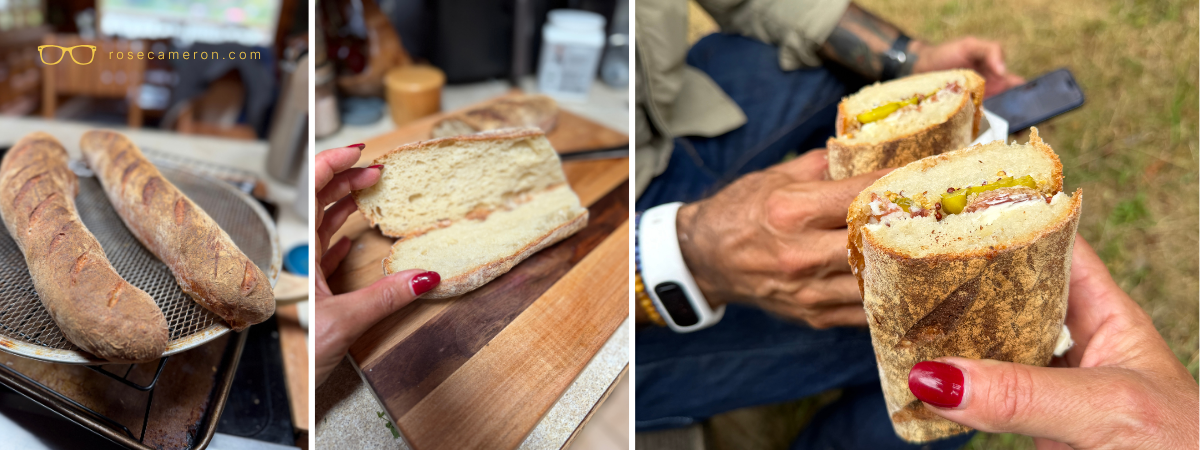
Homemade French Baguettes
Makes: 2 baguettes
Prep and fermentation: Approximately 5 1/2 hours on Day 2, mostly inactive
Bake time: 23 to 27 minutes
Additional cooling time: 45 minutes
Plus: 12 to 16 hours for the overnight poolish
Ingredients
For the poolish
150 g bread flour
150 g room-temperature water
1/8 teaspoon active yeast
For the final dough
All of the poolish
350 g bread flour
200 g cool water
10 g fine sea salt
1/2 teaspoon active yeast
Instructions
The night before baking, combine the poolish ingredients. Cover loosely and ferment at room temperature for 12 to 16 hours.
Combine the fermented poolish with the bread flour and water for the final dough. Mix until no dry flour remains and rest for 30 minutes.
Add the salt and yeast. Knead by hand for approximately eight minutes, until the dough is smooth and elastic but still slightly tacky.
Transfer to a lightly oiled bowl and cover. Bulk ferment for approximately 2 1/2 hours, performing stretch-and-folds after 30, 60, and 90 minutes.
Divide the dough into two equal portions. Pre-shape each into a log, cover, and rest for 20 minutes.
Shape each piece into a 15- to 17-inch baguette. Place in a floured couche or folded kitchen towel, cover, and proof for 45 to 60 minutes.
Meanwhile, preheat the oven to 475°F with a baking stone or steel and a sturdy empty pan for steam.
Transfer the baguettes to parchment or a peel. Score each loaf four or five times with slightly overlapping diagonal cuts.
Pour one cup of boiling water into the steam pan and immediately load the baguettes into the oven. Bake for 15 minutes.
Remove the steam pan or vent the oven, then continue baking for 8 to 12 minutes, until deeply golden.
Cool for at least 45 minutes before slicing.
Long Version Below:
The Poolish
The night before you want to make your baguettes, combine 150 grams of bread flour with 150 grams of room-temperature water and 1/8 teaspoon instant yeast.
Mix until there are no dry pockets of flour, cover loosely, and leave it at room temperature for approximately 12 to 16 hours. It should become bubbly and expanded and have a pleasantly yeasty, slightly nutty smell.
If life gets in the way, as it sometimes does, you can refrigerate the poolish once it has fermented. Take it out about 45 to 60 minutes before you are ready to make the final dough. It does not have to become completely warm. You are really just taking the chill off.
Making the Dough
Add the poolish to 350 grams of bread flour and 200 grams of cool water. Mix until you no longer see dry flour, then leave the mixture alone for 30 minutes.
After that rest, add 10 grams of fine sea salt and 1/2 teaspoon instant yeast. Knead the dough for about eight minutes by hand, until it becomes smoother and more elastic. It should still feel soft and slightly tacky. Resist the temptation to keep adding flour just because the dough feels sticky.
Transfer the dough to a very lightly oiled bowl, cover it, and let it ferment for about 2 1/2 hours.
During the first 90 minutes, give it three sets of stretch-and-folds, one after 30 minutes, another at 60 minutes, and the last at 90 minutes. You can do these directly in the bowl. By the end of the bulk fermentation, the dough should look noticeably puffier and feel smoother and more elastic. It does not need to double.
Shaping the Baguettes
Turn the dough onto a lightly floured surface and divide it into two equal pieces. Gently form each into a rough log, cover, and let them rest for 20 minutes.
Working with one piece at a time, gently pat it into a rectangle without pressing out all of the air. Fold the upper third toward the center and lightly seal it. Fold the lower portion toward the center and seal again. Fold the dough in half lengthwise and pinch the seam closed.
With the seam underneath, gently roll from the center outward until the baguette is approximately 15 to 17 inches long. You need a little friction between the dough and counter to create surface tension, so don't bury the counter in flour.
Place the shaped baguettes in a well-floured couche or kitchen towel, using folds of fabric between them to keep them from spreading. Cover and proof for approximately 45 to 60 minutes.
The clock is only a guide. Gently press the dough with a floured finger. If it springs back immediately, give it more time. If it slowly springs back while leaving a slight indentation, it is ready.
Baking
Preheat a conventional oven to 475°F with a baking stone or steel inside, if you have one. Place a sturdy metal or cast-iron pan on a lower rack for creating steam.
Transfer the baguettes to parchment or a baking peel and make four or five slightly overlapping diagonal cuts along the top with a very sharp razor or bread lame.
Pour about one cup of boiling water into the hot pan and immediately put the baguettes into the oven.
Bake for 15 minutes with the steam, then carefully remove the steam pan or briefly vent the oven. Continue baking for another 8 to 12 minutes, until the baguettes are deeply golden and crisp.
If using convection, reduce the temperature to about 450°F and begin checking them earlier because convection will brown the crust more quickly.
Let the baguettes cool for at least 45 minutes before cutting them. The inside of the bread is still finishing its work even after it comes out of the oven.