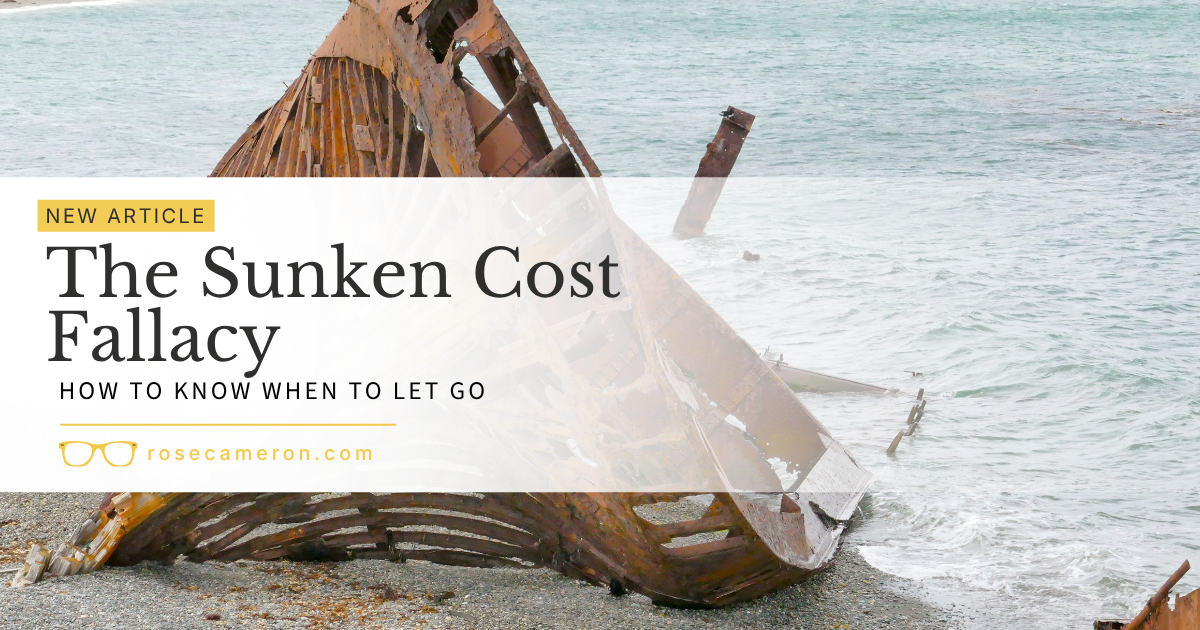
The Sunken Cost Fallacy
“You’re under no obligation to be the same person you were five minutes ago.” - Alan Watts
“I’ll just ride it out,” I said, not knowing how that was actually possible.
I knew that we were already in so much debt. I knew I was burned out, and I knew I was not fulfilled. The words felt heavy, as if no matter what I did, I was doomed to remain tied to my past decisions. At the time, I could not see that I was allowed to cut that burden free and move on.
We have all been there, holding onto something because we have already put so much time, energy, or money into it. It might be a failing project, a relationship that has lost its spark, a career that no longer fits, or even a hobby we no longer enjoy. The investment we have already made can begin to feel like a chain keeping us anchored to the past. This is where the sunken cost fallacy comes into play, and it can be a powerful force that prevents us from moving forward.
It becomes even more complicated when our identity is intertwined with the decision. I’m the owner of ____. I am the wife of ___. I am the captain of the team. These are not just choices anymore. They become part of the way we define ourselves and the way other people define us. Sometimes both we and the people around us find more comfort in our staying the same, even if we are unhappy, than in the uncertainty that comes with change.
What Is the Sunken Cost Fallacy?
The sunken cost fallacy is a cognitive bias that causes us to make decisions based on what we have already invested rather than on what continuing is likely to cost us in the future. It is the voice in your head saying, “I’ve already spent so much time on this, I can’t just quit now,” even when the situation is clearly no longer serving you.
I hear some version of this from nearly everyone, from entrepreneurs to busy moms, particularly as we reach our 40s and beyond. By this stage of life, we have often invested decades in our careers, our partners, the places we live, and even the identities we have created for ourselves. We say things like, “I’m introverted,” “I’m vegan,” “I love soccer,” or “I hate eggplant,” sometimes without stopping to consider whether those things are still true.
There is nothing wrong with consistency, but when we confuse consistency with obligation and assume that something must remain part of our life simply because it once was - we’ve got a problem.
Why We Fall Into the Trap
The sunken cost fallacy is rooted in our aversion to loss and our fear of the unknown. We hate the idea of having “wasted” time, money, or effort, so we convince ourselves that continuing will somehow validate our past decisions. If we just stick with it a little longer, perhaps everything we have already invested will finally become worthwhile.
Unfortunately, that thinking is flawed. When we cling to something that no longer serves us, we often continue pouring resources into a situation that is fundamentally broken. The time, money, emotional energy, and attention we continue to spend are unlikely to produce a positive return simply because we have already spent so much.
Imagine that you own a car that is constantly costing you money. Every week it needs another repair, another part, or another trip to the mechanic. It was once your dream car, but now it is unreliable and expensive. At some point, the fact that you once loved it does not change the fact that it no longer serves you.
And you are not just losing money - you are losing time and patience. The frustration starts spilling into other parts of your life, you are snapping at people, stress-eating, smoking again, showing up late, and damaging relationships because you are constantly dealing with the same problem. You still own the car you wanted so badly, but at what cost?
Now replace “car” with career, relationship, friendship, habit, business, house, or identity and the pattern becomes much easier to recognize.
How to Recognize the Sunken Cost Fallacy in Yourself
One of the clearest signs is feeling obligated not to “waste” what you have already invested. If you find yourself thinking, “I’ve already spent so much time or money on this, I can’t quit now,” pay attention. Your decision may be based more on your past investment than on the current or future value of continuing.
Another sign is ignoring evidence that something is not working. You may begin rationalizing setbacks, dismissing red flags, or creating explanations for why the situation will improve if you just hold on a little longer. Commitment can be admirable, but it can also become a way of avoiding reality.
The “just one more try” mentality is another clue. One more payment. One more adjustment. One more conversation. One more year. One more chance. Sometimes one more try is exactly what is needed. But if you have repeated the same cycle several times and nothing meaningful has changed, it is worth asking whether you are pursuing a solution or simply postponing a decision.
Fear and guilt can also keep us stuck. We worry that walking away will mean we failed, wasted time, disappointed someone, or made a terrible mistake. But staying in something harmful does not retroactively make the original decision better. It simply adds more time and energy to a choice that is already not working.
A sound decision should compare your present circumstances with your future options. If you are constantly comparing the future with what you have already spent, the past is doing too much of the decision-making.
The Unknown Versus the Known
Imagine you are standing in neck-deep water in the middle of a deep lake. Depending on where you are in life right now, that may not feel like much of a stretch. You are barely keeping your head above water. Maybe the problem is financial or you are constantly fighting with your spouse. Maybe it is an addiction you cannot quite shake, a job that drains you every day, or even the nightmare car I mentioned earlier. Whatever the issue is, it has not served you for a long time, yet you continue struggling to keep it afloat.
The longer you struggle, the more exhausted you become. Eventually, the effort required simply to maintain the situation can leave you with very little energy for anything else. Something does not deserve the rest of your life simply because it once served you. You cannot swim to shore with a lead weight tied around your waist, no matter how hard you swim, moving forward requires letting go of what is dragging you down.
This is where change becomes difficult. We know the discomfort of what we already have. We know what it costs us, who accepts us as we are, and what each day is likely to look like and oddly there can be a strange comfort in a familiar misery.
What we do not know is what freedom will feel like. We do not know who will still be there as we change. We do not know what other parts of our life will shift when we finally make a different choice.
The fear of the unknown often outweighs the pain of the present until something changes. Eventually, we begin to understand that staying where we are may be riskier than leaving. Once we acknowledge that we have the ability to choose a better future, even an uncertain one, we can begin to move forward.
How to Break Free
Ask Objective Questions: A useful place to start is by shifting your focus away from what you have already invested and toward what you would choose now. Ask yourself, “If I had no history with this, would I start today?” Would I choose this job today? Would I date this person today? Would I buy this house today? Would I make this investment today? That question is powerful because it removes history from the equation. It asks you to look at the current reality rather than the story attached to it.
Practice Self-compassion: Changing direction does not automatically mean you failed. Sometimes quitting is simply learning. Every decision gives you information. You discover what works, what does not, what you value, and what you are no longer willing to tolerate. Time or money that did not produce the result you wanted does not define your worth.
Get Objective Feedback: Talk to someone you trust who is not emotionally invested in the situation and whose judgment you respect. When we are deeply involved in something, our thinking can become distorted by fear, loyalty, hope, and habit. Someone standing outside the situation may be able to see what we cannot.
Get Practical: Compare the real costs and benefits of continuing with the costs and benefits of leaving. Be honest about what the situation is giving you now, not what it used to give you or what you hope it may eventually become.
Establish an Exit Plan: If you are not ready to walk away immediately, establish clear exit criteria. Decide what would need to happen for you to continue and what would signal that it is time to leave. “If I am still in the same place three months from now, I will make a change” is far more useful than allowing the situation to continue indefinitely.
Weigh What You’re Losing By Staying: Remember opportunity cost. Every hour, dollar, and ounce of emotional energy you continue putting into one thing is energy you cannot use somewhere else. Sometimes the most important question is not, “How much have I already invested?” but, “What am I giving up by continuing?”
The Power of Letting Go
You have one precious life, and the amount of time you have left is uncertain. The true measure of your worth is not found in the things you cling to out of habit, fear, or past investment. It is found in the choices you make as you move forward.
Letting go does not always mean walking away dramatically, sometimes it means asking your partner to go to counseling and being willing to admit your own role in what has gone wrong. Sometimes it means asking for help. It might mean realizing you are upside down on your mortgage and finding a roommate to reduce the financial pressure. It might mean having an honest conversation with your boss, changing departments, or working with a recruiter to find something new.
It could also mean admitting that you no longer want the career you spent years building and being willing to learn a new skill. Or, in my case, it might look something like packing up your house and moving to a Greek island full of cats, sunshine, and dancing.
There are almost always more possibilities available to us than we can see when we are exhausted. When most of your energy is being spent holding together something that is already falling apart, you do not have much left for imagining a different life. Letting go creates space. It gives you the energy to look forward instead of constantly looking backward. It allows you to consider possibilities that were invisible while you were consumed with maintaining the status quo.
Your future self may look back and thank you for having the courage to make a different choice.
My deepest wish is that each of you understands that you are worthy of a wildly fulfilling and joyous life. It took me years to convince myself of the same, but from this side of things, I can tell you this with complete confidence: you are.
Looking for a sounding board or some objective feedback? Feel free to message me anytime or get a 15-minute free call!
xo,
Rose